What Happens When AI Stops Being the Attraction — and Starts Understanding the Participant?
Artificial intelligence is rapidly becoming part of the live events industry. But displaying AI and creating a meaningful experience with AI are two very different things.
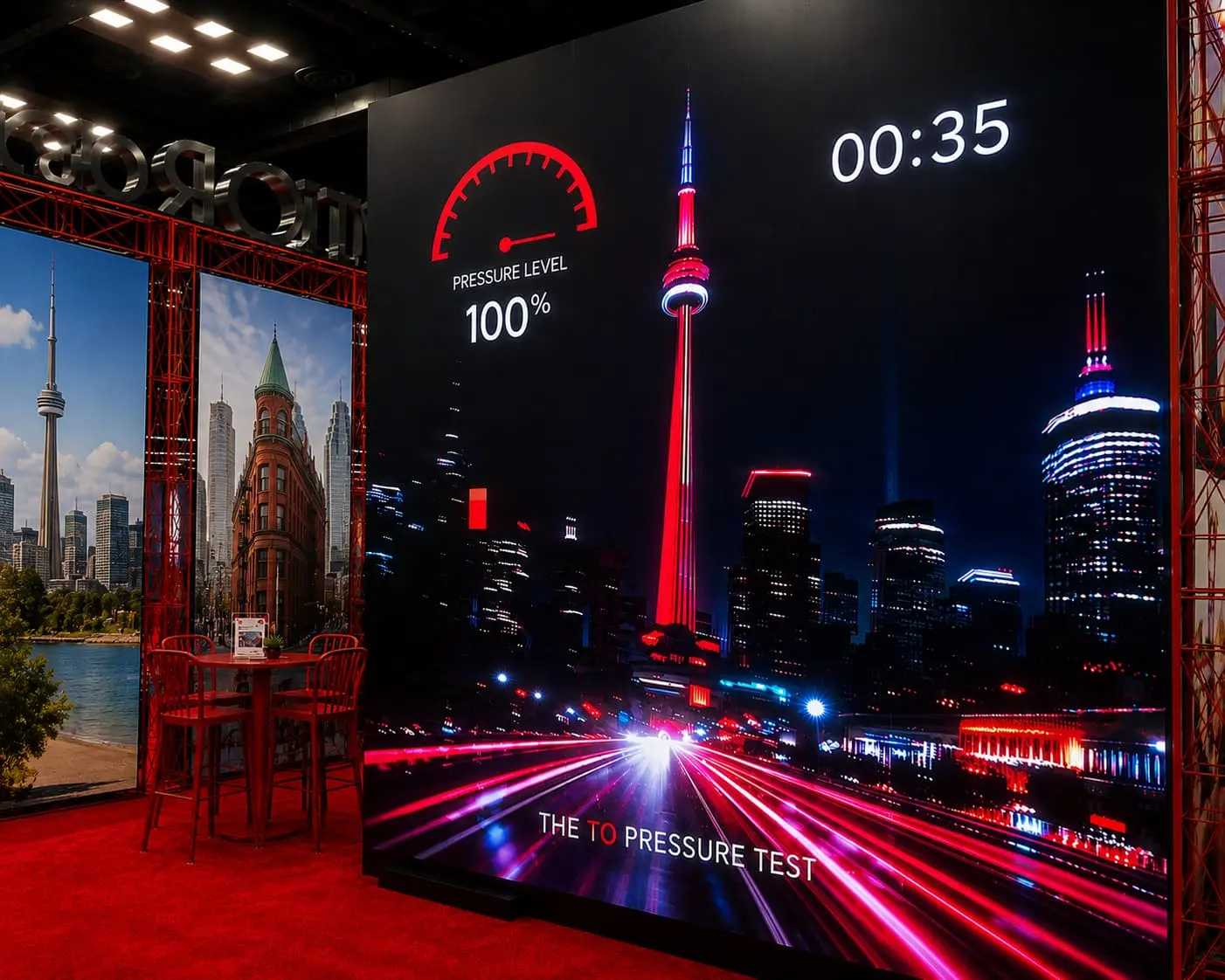
At the ASAE Annual Meeting & Exposition 2026 in Indianapolis, Destination Toronto took a different approach. Instead of asking attendees to watch an AI demonstration, the destination invited them to participate in The TO Pressure Test — an interactive AI-powered experience built around a simple but compelling question: how do you respond when the pressure is on?
Destination Toronto documented the activation on its official channels, describing it as a fast-paced leadership challenge staged at Booth #1825 throughout the August 15–18 show — built around the idea that in just 60 seconds, with multiple priorities competing for attention, a single leader has to decide. Participants worked through a sequence of high-stakes scenarios, and at the end of the journey could discover their own leadership profile and take home a personalized leadership toolkit.
That public framing confirms the shape of the experience. What it doesn't cover — because it lived entirely inside NewMedia's build — is how the AI actually got there: how a person's choices during the challenge were interpreted in real time and turned into individual feedback about how they approach pressure and decision-making.
The result was not a generic piece of content shown to thousands of visitors. It was an experience built around one person at a time. And that distinction represents one of the most important opportunities for artificial intelligence in experiential marketing.
From Questions to a Personalized AI Experience
The interaction was intentionally simple. Participants entered the experience and were presented with a series of situations designed to place them in hypothetical high-pressure scenarios. Each decision became another piece of information.
Rather than treating those answers as the end of a conventional questionnaire, the system used them as inputs for the experience. As participants progressed through The TO Pressure Test, their responses created an increasingly individualized picture of how they approached stressful situations. At the end of the journey, the experience transformed those decisions into a personalized result reflecting their approach to pressure and decision-making.
This created a fundamental shift in the relationship between technology and attendee. The participant was no longer interacting with content. The participant became the content.
Instead of delivering the same message to every visitor, AI can allow brands and organizations to create experiences that listen, interpret and respond — one event, thousands of possible interactions, and an experience that can feel personal to every participant.
Why The TO Pressure Test Worked at ASAE 2026
The context mattered. ASAE 2026 brought more than 5,500 attendees to Indianapolis, while pre-event audience data published by Visit Indy showed that 71% of attendees were final decision-makers or significantly influenced purchasing decisions, and 62% were director-level or above.
For an audience built around leadership, organizational responsibility and decision-making, The TO Pressure Test was designed around something they experience every day: making choices when time is limited and priorities compete.
Rather than presenting a generic piece of content to an event audience of more than 5,500 attendees, the experience focused on one participant at a time. Each person faced a rapid sequence of high-pressure scenarios, made their own decisions and received a personalized leadership profile based on how they responded.
That combination of relevance, participation and personalization transformed the experience from something attendees simply watched into something they became part of — while giving Destination Toronto a meaningful way to connect its brand with leadership, adaptability and human decision-making.
Beyond the Booth: Extending the Experience After ASAE
The TO Pressure Test did not end when participants stepped away from Booth #1825.
Following ASAE 2026, Destination Toronto continued the conversation around the activation by sharing the leadership profiles generated through the experience: Visionaries, Catalysts, Strategists and Connectors.
Destination Toronto later reported that 159 association leaders took part in The TO Pressure Test during ASAE 2026, providing a measurable indication of attendee participation in the activation.
This post-event communication extended the experience beyond the physical trade show environment. What began as a 60-second interactive challenge became a personalized result participants could identify with, while giving Destination Toronto an additional opportunity to continue the brand conversation after the event.
For experiential marketing, this is an important distinction. The value of an AI-powered activation is not only the moment of interaction itself, but its ability to generate personalized outcomes, memorable content and additional touchpoints that can continue working after the live experience is over.
The TO Pressure Test demonstrated how AI, interactive technology and experience design can work together to turn a trade show interaction into a more personal and lasting connection between a destination brand and its audience.
AI Personalization Is Changing Experiential Marketing
For decades, event marketing has largely followed a one-to-many model: one presentation, one video, one booth message, one experience delivered to everyone. Artificial intelligence introduces a fundamentally different possibility: personalization at live-event scale.
An AI-powered installation can respond to an attendee's answers, choices, movements, voice, preferences or other intentionally provided inputs and adapt the experience accordingly. That means a trade show activation can stop behaving like a digital billboard and begin behaving more like an intelligent conversation.
The TO Pressure Test demonstrates one version of this model: the participant provides input, the system interprets it, the experience responds, and the visitor receives something personally relevant in return. For brands, destinations and organizations, this opens an entirely new creative territory for experiential marketing — personalized brand journeys, interactive leadership experiences, scenario-based challenges, AI-generated visitor profiles, adaptive storytelling, and real-time content generation, among others.
The objective is not simply to put AI inside an event. It is to use AI to make the event respond to the person standing inside it.
From MetaHuman Choir to The TO Pressure Test: Two Different Roles for AI
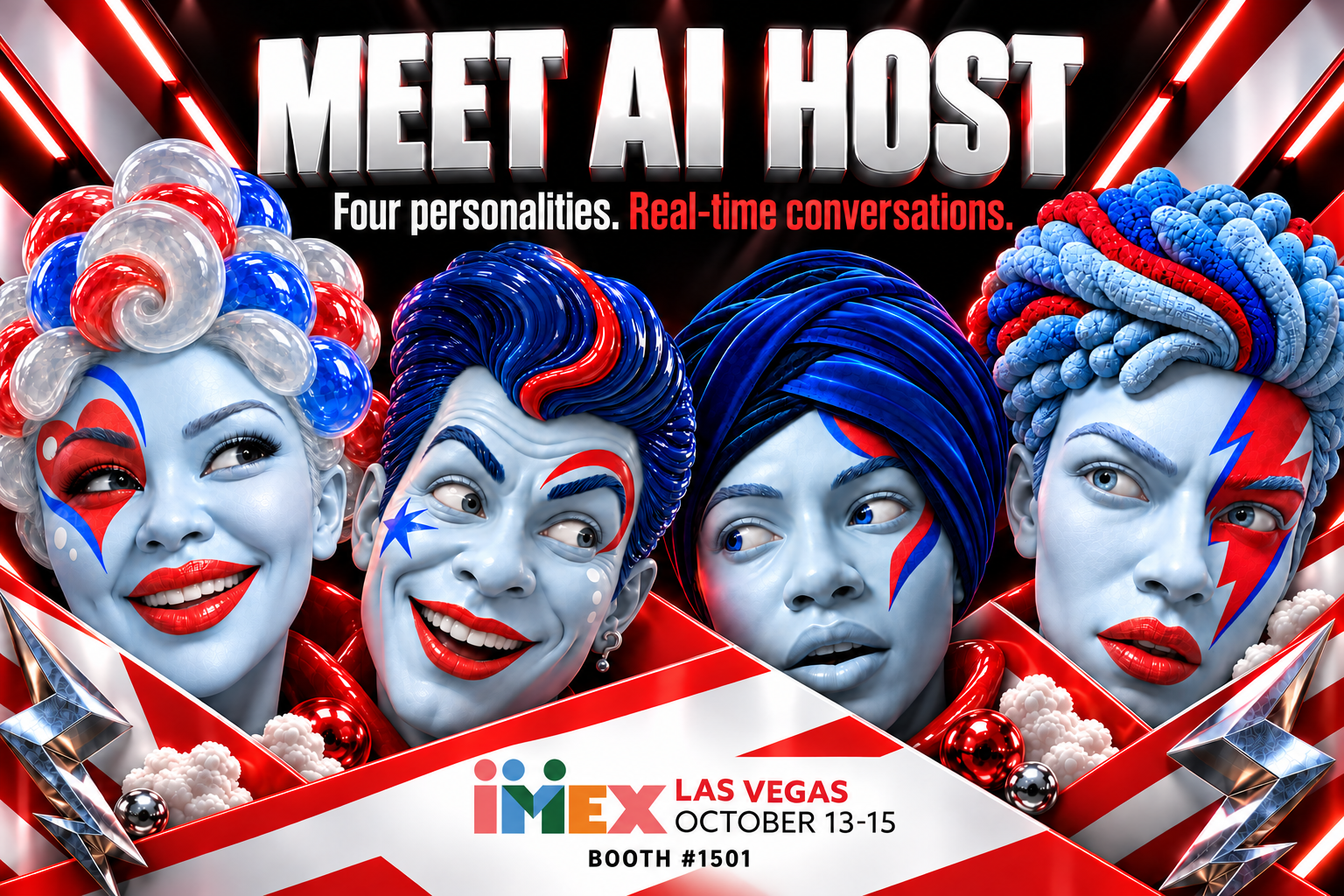
Earlier in 2026, NewMedia explored another side of artificial intelligence with the MetaHuman Choir at IMEX Frankfurt. That activation transformed AI into performance: four large-scale digital performers created an interactive audiovisual experience in which attendees could influence what happened in real time.
The TO Pressure Test explores a different dimension. Here, AI is not primarily performing for the audience — it is responding to the individual. With the MetaHuman Choir, interaction changed the performance. With The TO Pressure Test, interaction changed the participant's own experience.
Together, the two projects demonstrate the breadth of what AI can already do inside live environments: AI as performer, AI as responsive system, AI as personalization engine, AI as storytelling tool, and AI as a bridge between physical experiences and individual data. The real opportunity ahead is creating physical experiences that can understand input and respond differently to every participant.
Destination Marketing Beyond the Traditional Trade Show Booth
The TO Pressure Test also represents an interesting evolution in destination marketing. Destination marketing organizations traditionally compete for attention using imagery, video, hospitality and destination storytelling — but trade show audiences already know what Toronto looks like. The challenge is creating a reason to stop, then a reason to participate, then a reason to remember who created the experience.
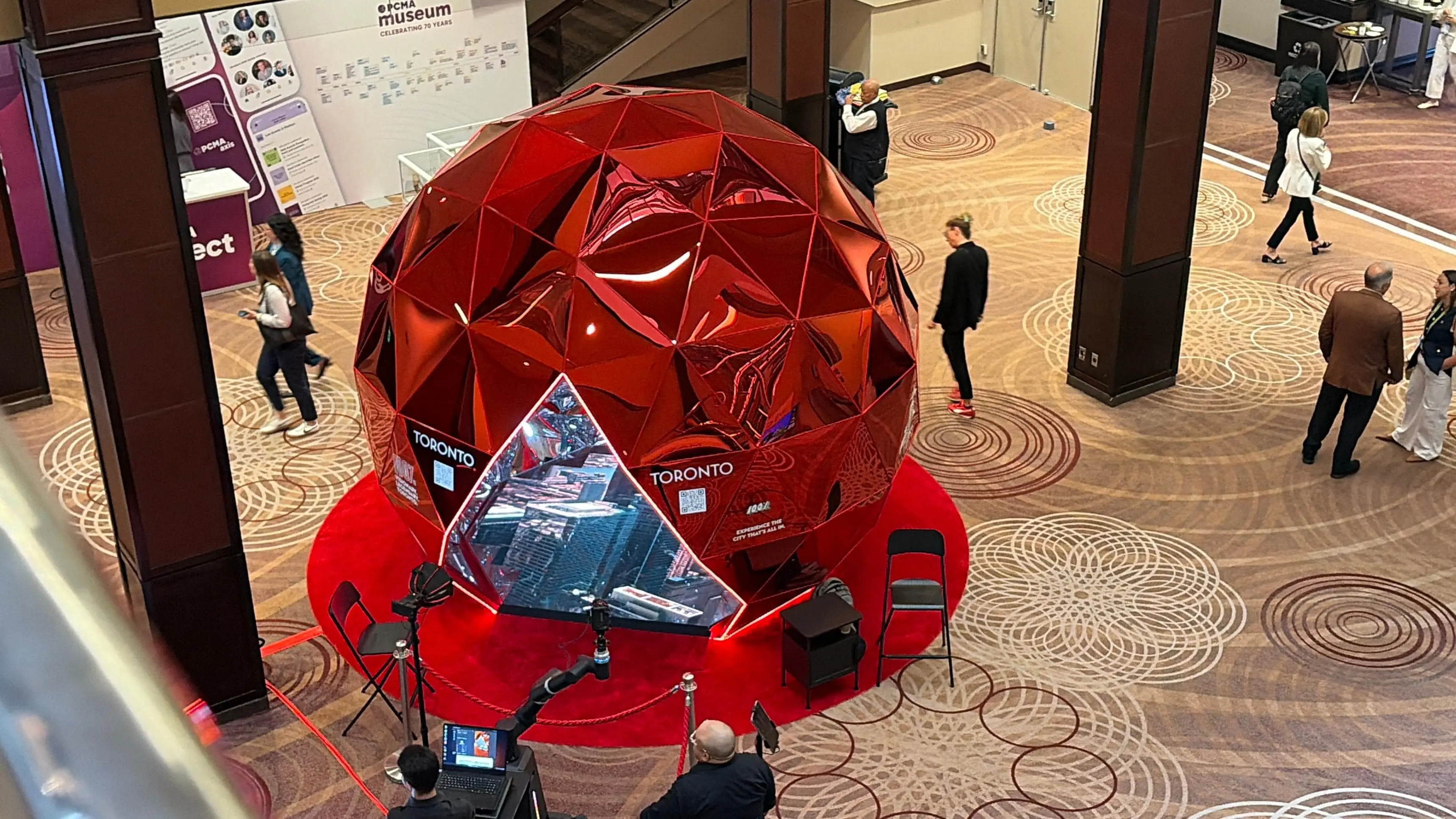
Destination Toronto has consistently explored experiential technology as part of that strategy. NewMedia has previously worked with Destination Toronto on immersive activations including MirrorDome at Rendez-vous Canada, bringing experiential destination storytelling to major industry events across North America and Europe.
The TO Pressure Test takes that strategy in another direction. Instead of immersing attendees in Toronto visually, it creates engagement through curiosity and personalization — the destination becomes associated not simply with a place, but with an experience. For DMOs, tourism boards and convention bureaus competing on crowded exhibition floors across the United States and Canada, that distinction can be extremely valuable.
The Experience Comes First. The AI Comes Second.
There is an important lesson behind both The TO Pressure Test and the MetaHuman Choir. Successful AI activations should not begin with “how can we use AI at this event?” They should begin with “what should the audience experience?” Only then should technology enter the conversation.
In The TO Pressure Test, the objective was not to demonstrate an AI model. The objective was to create curiosity, participation and a personalized moment around leadership and decision-making under pressure. AI made that experience possible.
This philosophy guides NewMedia's approach to creative technology: combining experience design, interactive systems, artificial intelligence, real-time content, immersive environments and live-event production to build technology around an idea — rather than forcing an idea around a technology.
Building AI Experiences for Live Events in the United States and Canada
Creating AI for a live event is different from building an online AI application. Hundreds or thousands of attendees may interact with the system. Responses need to happen quickly. Interfaces need to be immediately understandable. AI outputs need appropriate guardrails. Hardware, software, content and physical production need to operate as one system — continuously, on the show floor.
NewMedia Creative Technology Studio designs and produces AI-powered experiences from concept through onsite deployment, combining custom interactive development, generative AI, real-time systems, immersive technology and event production. With operations serving the United States and Canada, we develop AI-powered experiences for trade shows, corporate events, conferences, destination marketing, exhibitions and brand activations throughout North America.
Creating the Next AI-Powered Event Experience
The MetaHuman Choir at IMEX Frankfurt 2026 demonstrated how artificial intelligence can become a live performance. The TO Pressure Test for Destination Toronto at ASAE 2026 demonstrated how AI can turn attendee decisions into personalized experiential storytelling. Different experiences, different technologies, the same principle: AI becomes far more powerful when people don't simply watch it — they become part of it.
NewMedia Creative Technology Studio develops custom AI-powered activations, interactive installations and immersive experiences for brands, destinations and organizations across the United States, Canada and international markets. Because the future of event technology isn't about adding AI to events. It's about creating experiences that were not possible without it.