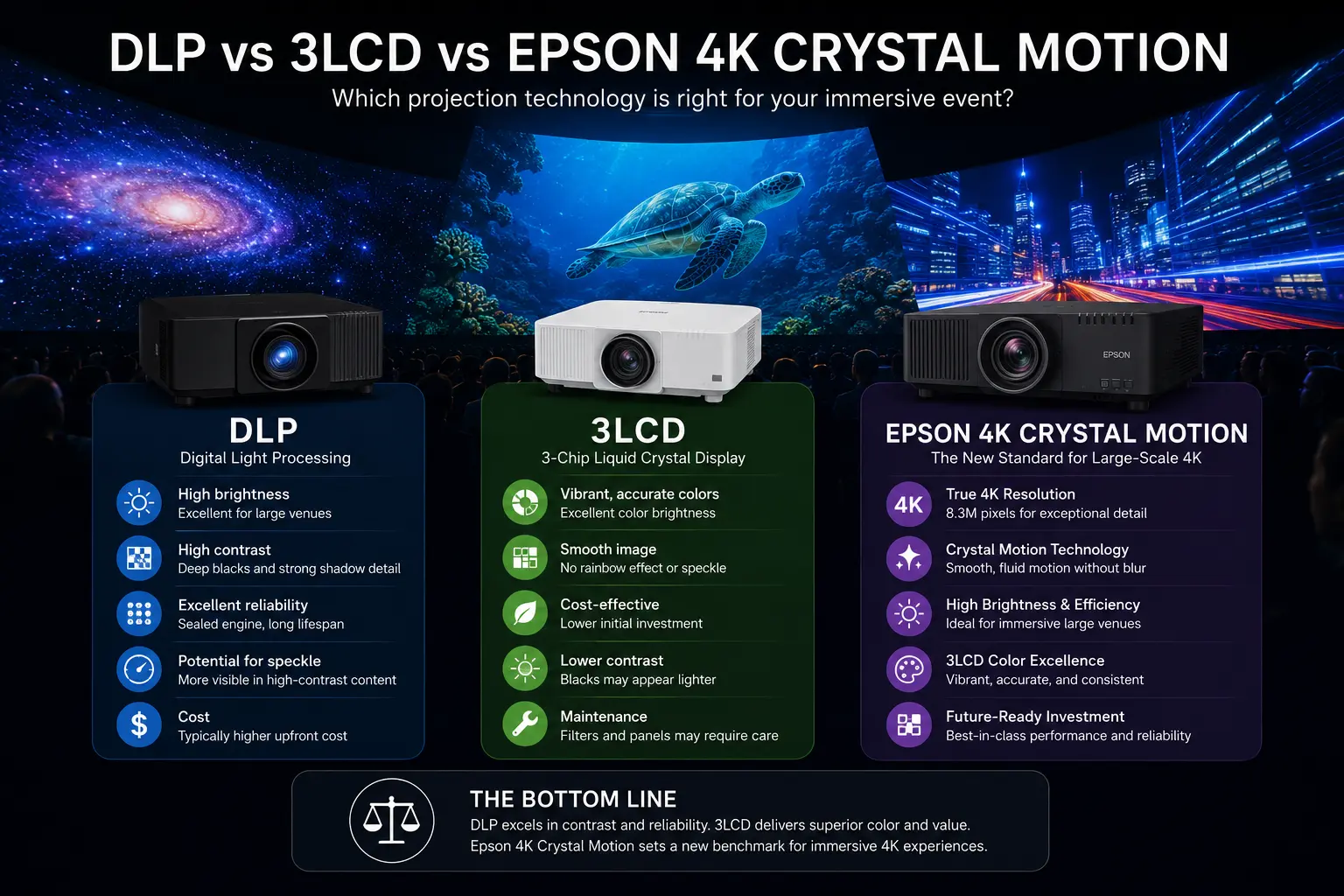
Two Technologies, One Decision
When event producers and technical directors specify projection for a dome show, a 3D mapping activation, or a large-scale immersive installation, one of the earliest and most consequential decisions is the choice of projection technology. The two dominant options in the professional market are DLP (Digital Light Processing) and 3LCD — and they work in fundamentally different ways.
Understanding those differences — and what they mean in real production conditions — is essential for anyone commissioning or specifying projection for high-stakes events.
How DLP Works
DLP technology was developed by Texas Instruments in 1987 and remains one of the most widely used projection technologies in professional large-venue applications. DLP projectors use a Digital Micromirror Device (DMD) chip — a semiconductor containing millions of microscopic mirrors, each representing a single pixel. These mirrors tilt at high speed to reflect light toward or away from the lens, modulating brightness at the pixel level.
Single-chip DLP projectors use a spinning color wheel to produce color sequentially — red, green, and blue in rapid succession. Three-chip DLP projectors (3DLP), used in high-end professional units from manufacturers like Christie and Barco, dedicate one DMD chip to each primary color, combining them optically to produce a continuous full-color image without a color wheel.
The key structural advantage of DLP is that its imaging component — the mirror — is reflective. It does not absorb light or heat in the way that transmissive technologies do. This has significant implications for long-term color stability.
How 3LCD Works
3LCD technology was developed by Epson in the 1980s and works on a fundamentally different principle. White light from the light source is split into red, green, and blue components using dichroic mirrors. Each color passes through a dedicated LCD panel that modulates the light to create the image for that color channel. The three color images are then recombined and projected through a single lens.
Because all three colors are present simultaneously — rather than sequentially as in single-chip DLP — 3LCD projectors produce high color brightness and strong color saturation. This is a genuine advantage in environments where color fidelity is the primary requirement.
The structural limitation of 3LCD is that the LCD panels are transmissive — light passes through them rather than reflecting off them. Over time, the heat and light absorbed by the panels causes the liquid crystal compounds to degrade. Critically, the three panels degrade at different rates, which gradually shifts the color balance of the image. This is the origin of the yellowing effect that many professionals who have worked with older 3LCD projectors will recognise — whites taking on a warm or yellow tint after extended use.
Has Laser Solved the Yellowing Problem?
The transition from lamp-based to laser light sources has significantly improved the color longevity of 3LCD projectors. A laser light source maintains more consistent color output over its rated lifespan — typically 20,000 hours in professional units — compared to traditional lamps, which degraded visibly in both brightness and color temperature from early in their operational life.
However, the laser light source addresses only part of the degradation equation. The LCD panels themselves remain transmissive components that absorb heat, and their differential degradation over time is a structural characteristic of the technology rather than a function of the light source. Modern laser 3LCD projectors are considerably more color-stable than their lamp-based predecessors, but DLP's fundamental advantage in long-term color consistency — derived from the reflective nature of its imaging component — remains intact.
For productions where projectors will operate for thousands of hours across multiple events — permanent installations, touring productions, multi-day conferences — this distinction is worth factoring into the specification decision.
What Is 4K Crystal Motion Technology?
Epson's 4K Crystal Motion technology, featured in projectors including the recently launched EB-XQ2030B presented at ISE Barcelona in February 2026, is not a new projection technology in the fundamental sense. It is an image processing technique applied on top of Epson's existing 3LCD architecture.
Crystal Motion uses pixel shifting — rapidly displacing the projected image by fractions of a pixel between frames — to simulate 4K resolution from panels that are not natively 4K. The result is a 4K-class image at the output, but the underlying resolution of the imaging panels is lower than true native 4K.
This approach is not unique to Epson. Pixel shifting to simulate higher resolution has been used by multiple projector manufacturers for several years. It produces results that are visually impressive and in many applications indistinguishable from native 4K — but it is important for technical specifiers to understand what they are evaluating. A projector described as "4K" via Crystal Motion technology is delivering simulated 4K through pixel shifting, not native 4K resolution from the imaging chip.
The EB-XQ2030B does represent a genuinely significant engineering achievement in other respects: 30,000 lumens in a form factor 53% smaller and 42% lighter than previous projectors in its class is a meaningful advancement for rental and staging applications where transport, rigging, and deployment logistics are significant operational factors.
DLP vs. 3LCD in Practice: What Matters for Immersive Events
From a professional event production perspective, the choice between DLP and 3LCD is rarely absolute — it depends on the specific requirements of the installation. Here is how the technologies compare across the dimensions that matter most in immersive and large-venue event production:
Contrast and black levels: DLP holds a clear advantage. The reflective DMD chip delivers deeper blacks and higher native contrast ratios than 3LCD panels. In dome projection and mapping applications where dark environments are standard, contrast quality has a direct impact on the perceived depth and realism of the image.
Color brightness: 3LCD has a structural advantage. Because all three colors are projected simultaneously, 3LCD projectors produce higher color light output relative to white light output than single-chip DLP. This matters in applications where saturated color rendition is the primary objective.
Long-term color stability: DLP has a structural advantage. The reflective DMD chip does not degrade in the way that transmissive LCD panels do. For high-utilisation installations, DLP will maintain more consistent color balance over time.
Rainbow effect: Single-chip DLP projectors can produce a color fringing artefact — sometimes called the rainbow effect — visible to sensitive viewers when the eye or image moves rapidly. Three-chip DLP (3DLP) eliminates this entirely. 3LCD has no equivalent artefact.
Size and weight at high brightness: The new generation of Epson 3LCD laser projectors, including the EB-XQ2030B, is closing the gap with DLP in terms of physical footprint at equivalent brightness levels — a practical advantage for rental and staging operations.
Maintenance: DLP projectors with sealed optical engines require minimal maintenance. 3LCD projectors — even modern filterless designs — involve more complex optical assemblies with a greater number of components subject to heat-related wear.
The Bottom Line for Event Producers
DLP remains the professional standard for large-scale immersive installations, dome projection, and architectural mapping where contrast quality, long-term color stability, and reliability under intensive use are the primary requirements. The world's most demanding permanent and touring immersive productions — from major dome theatres to architectural spectaculars — are overwhelmingly specified with 3DLP technology.
3LCD with laser is a strong and cost-effective option for events where color brightness is the priority, operational hours are moderate, and the size and weight advantages of the latest generation of Epson projectors are relevant to the logistics of the deployment.
4K Crystal Motion technology is a capable image processing solution that delivers impressive visual results. Specifiers should understand that it produces simulated rather than native 4K resolution — a distinction that matters for productions where technical accuracy in specification is required.
As with all technology decisions in professional event production, the right answer depends on the specific requirements of the project. Understanding what each technology actually does — and where its genuine advantages and limitations lie — is the foundation of a well-specified production.
.webp)