Introduction
Only a few years ago, artificial intelligence was considered an emerging technology—an interesting innovation with potential but limited practical applications in live events. Today, that perception has completely changed.
Artificial intelligence has become one of the most transformative forces in experiential marketing, fundamentally changing how brands interact with audiences at exhibitions, conferences, product launches, museums, visitor centers, and corporate events.
The reason is simple.
People no longer attend events simply to receive information. Information is available everywhere. They attend because they want to experience something they cannot experience through a website, a social media campaign or a television commercial.
Visitors expect interaction.
They expect personalization.
They expect technology to respond to them.
Most importantly, they expect to become part of the story rather than simply watching it.
Artificial intelligence makes that possible.
Instead of presenting identical content to every visitor, AI allows experiences to adapt in real time according to each person's interests, questions, emotions, behavior and decisions.
Every interaction becomes unique.
That is why AI is no longer simply another technology available to event organizers—it has become a completely new creative medium.
Why AI Is Changing Experiential Marketing Forever
Experiential marketing has always been about creating emotional connections.
People rarely remember product specifications.
They rarely remember statistics.
They almost never remember brochures.
They remember experiences.
They remember emotions.
They remember stories.
For decades, brands attempted to create memorable experiences through increasingly spectacular physical installations:
Larger exhibition stands
Bigger LED walls
Projection mapping
Interactive touchscreens
Virtual Reality
Augmented Reality
Kinetic sculptures
Each technological evolution made experiences more impressive.
Artificial intelligence introduces something fundamentally different.
Instead of simply displaying content, it creates conversations.
Instead of reacting to predefined buttons, it reacts to people.
Instead of following a programmed sequence, it continuously adapts.
This represents the biggest transformation in experiential marketing since digital projection replaced traditional static displays.
From Passive Visitors to Active Participants
Traditional exhibitions follow a predictable model.
Visitors walk through an exhibition.
They observe products.
Someone explains features.
They receive a brochure.
The interaction ends.
Artificial intelligence completely changes this relationship.
Imagine entering an exhibition where a digital human immediately welcomes you.
Instead of following a predefined presentation, it asks questions.
It learns what interests you.
It adapts its vocabulary according to your professional background.
It understands your language.
It changes examples according to your industry.
It recommends different products depending on your objectives.
Every visitor receives a completely different experience.
This personalization creates something extremely valuable: attention.
Attention has become one of the world's most valuable resources.
Companies are no longer competing only against competitors. They are competing against smartphones, notifications, social media and information overload.
The brands that capture attention create memorable experiences.
AI dramatically increases the probability of achieving exactly that.
The New Definition of an AI Brand Activation
Many companies believe that adding ChatGPT to a screen automatically creates an AI experience.
It does not.
An AI brand activation is much more than an AI chatbot.
A true AI activation combines three essential elements.
1. Storytelling
Technology without narrative is simply technology.
Visitors rarely remember impressive hardware.
They remember how that experience made them feel.
Every successful activation begins with a story.
Not with software.
Not with hardware.
Not with artificial intelligence.
The narrative always comes first.
2. Interaction
Interaction is what transforms spectators into participants.
Visitors should influence the experience.
They should feel that their decisions matter.
Examples include:
Speaking naturally with AI
Changing environments through gestures
Generating personalized visual content
Influencing projection mapping
Creating music collaboratively
Controlling lighting through movement
Designing products in real time
The more visitors influence the experience, the stronger the emotional connection becomes.
3. Personalization
This is where artificial intelligence changes everything.
Traditional experiences are identical for everyone.
AI experiences are unique.
Two visitors entering simultaneously may experience completely different conversations, recommendations, visuals and endings.
Personalization transforms an installation from impressive into unforgettable.
The Technologies Behind Modern AI Experiences
Artificial intelligence is not a single technology.
It is an ecosystem.
The world's most successful immersive activations combine multiple technologies simultaneously.
Large Language Models
Large Language Models, or LLMs, allow visitors to communicate naturally.
Instead of pressing buttons, they simply speak.
The interaction feels human.
Questions become conversations.
Conversations become experiences.
The AI can explain products, recommend destinations, teach scientific concepts, guide museum visitors, interview job candidates, present corporate strategies or simply entertain audiences.
The important point is not that AI can answer questions.
It is that AI can create a dialogue.
Dialogue is infinitely more engaging than presentation.
Digital Humans
Digital humans are becoming the new face of experiential marketing.
Unlike traditional avatars, digital humans can maintain eye contact, display realistic facial expressions, synchronize lips naturally, speak multiple languages, understand context and react emotionally.
They combine conversational AI with photorealistic animation.
The result is an interaction that feels remarkably natural.
Companies are already using digital humans as exhibition hosts, museum guides, tourism ambassadors, product specialists, healthcare educators, luxury brand representatives and virtual CEOs.
Unlike human presenters, they never become tired. They always deliver consistent information. They speak multiple languages and can remain available continuously.
Computer Vision
Computer vision allows installations to understand what visitors are doing.
Rather than asking users to press buttons, the system observes naturally.
It can recognize body movement, hand gestures, facial expressions, audience density, walking patterns and interaction time.
This information can trigger dynamic content.
Imagine walking through an immersive tunnel.
As more visitors enter, the visuals become richer. The soundtrack changes. Lighting adapts. Content evolves.
The environment feels alive.
That sensation is what makes immersive experiences memorable.
Designing an AI Brand Activation That People Actually Remember
One of the biggest misconceptions in the events industry is that memorable experiences are created by expensive technology.
They are not.
Some of the most successful brand activations in the world use surprisingly simple technology supported by exceptional storytelling.
Likewise, many six-figure installations fail because they prioritize equipment over experience.
Artificial intelligence should never become the protagonist.
The visitor should.
The role of technology is to make visitors feel intelligent, creative, curious or inspired—not to demonstrate how sophisticated the software is.
Before selecting hardware, software or suppliers, every project should answer four simple questions:
Who is the audience?
What emotion should they experience?
What action should they take afterwards?
How will success be measured?
Everything else should support those answers.
The Four Layers of Every Successful AI Activation
Layer One — Attraction
The first challenge is surprisingly simple.
People must decide to stop.
Trade shows are crowded environments.
Visitors are constantly bombarded with screens, lights, sounds and sales messages.
Most booths fail before a conversation even begins.
Artificial intelligence can dramatically improve attraction by making installations appear alive.
Examples include:
A digital human making eye contact with people walking past
A projection-mapped façade reacting to movement
A Mirror Dome reflecting the environment while revealing unexpected digital content
An AI voice inviting visitors by name after reading their badge, with appropriate consent
Generative visuals that constantly evolve instead of looping every few minutes
Movement attracts attention.
Unexpected behaviour maintains it.
Layer Two — Engagement
Attraction lasts seconds.
Engagement lasts minutes.
This is where artificial intelligence begins creating value.
Visitors should never become passive spectators.
Instead, they should influence what happens.
Good interactions include asking questions naturally, designing products with AI, exploring destinations through conversation, creating personalized artwork, participating in collaborative games, influencing music through movement and controlling immersive environments.
The more control visitors have, the stronger their emotional investment becomes.
Layer Three — Memory
Memory is where experiential marketing delivers its greatest return.
People rarely remember every detail.
They remember moments.
Emotionally significant experiences are remembered more clearly than purely informational ones.
Artificial intelligence creates memorable moments because every visitor experiences something unique.
Imagine two colleagues entering the same activation.
One speaks with an AI explorer.
The other creates personalized digital artwork.
Both leave with different memories.
Both share different stories.
That uniqueness increases word-of-mouth marketing naturally.
Layer Four — Conversion
Many agencies stop after creating an impressive experience.
Brands cannot.
Every activation should contribute to measurable business objectives.
Examples include qualified leads, product demonstrations, newsletter subscriptions, appointment bookings, tourism inquiries, museum ticket sales, social media sharing and retail purchases.
Artificial intelligence makes conversion feel less intrusive because recommendations emerge naturally through conversation rather than aggressive sales techniques.
AI and Immersive Architecture
Artificial intelligence becomes dramatically more powerful when combined with physical space.
This is where immersive architecture changes everything. NewMedia is now applying this approach to AI-powered immersive dome experiences, combining responsive AI systems with 360° projection and live audience input.
People do not remember screens.
They remember environments.
The architecture surrounding an experience shapes perception long before the technology begins interacting.
That is why immersive spaces consistently outperform traditional exhibition booths in visitor engagement.
Immersive Domes
Few environments demonstrate this better than immersive domes.
Unlike conventional rectangular spaces, domes eliminate visual distractions.
Visitors become surrounded by content.
Instead of looking at a presentation, they enter it.
Artificial intelligence introduces another dimension.
Imagine entering an immersive dome where the experience evolves according to audience behaviour.
Families receive playful narratives.
Corporate executives receive business-focused presentations.
Children influence the story through movement.
International visitors automatically receive content in their native language.
The architecture remains identical.
The experience changes completely.
This level of personalization was almost impossible only a few years ago.
Projection Mapping
Projection mapping has traditionally been a one-way communication medium.
Spectacular. Beautiful. But fundamentally linear.
Artificial intelligence transforms projection mapping into something far more dynamic.
Imagine a historic building becoming an intelligent storyteller.
Visitors ask questions.
The façade responds.
Architectural elements illuminate according to the conversation.
Historical characters appear.
Scientific concepts become visual.
Tourism experiences become interactive journeys rather than passive spectacles.
Projection mapping no longer simply decorates architecture.
It gives architecture a voice.
Digital Twins
Digital twins represent another major opportunity.
A digital twin is a virtual representation of a physical object, building or environment.
Artificial intelligence allows visitors to interact naturally with those models.
Imagine exploring an airport before construction begins, a future museum, an entire smart city, a new automobile factory or a luxury resort.
Instead of watching animations, visitors ask questions:
“What happens if we increase capacity?”
“How much energy would this save?”
“What would this look like at night?”
The experience becomes exploratory instead of explanatory.
Measuring ROI Beyond Visitor Numbers
One of the biggest mistakes in experiential marketing is measuring success only by counting visitors.
Attendance tells very little.
Meaningful metrics include the following.
Dwell Time
How long did visitors remain?
Longer engagement generally correlates with stronger emotional impact.
Completion Rate
Did visitors complete the experience or leave halfway through?
High completion rates usually indicate intuitive interaction design.
Conversation Quality
For AI experiences, quality matters more than quantity.
Did visitors ask meaningful questions?
Did conversations evolve naturally?
Did they request additional information?
Qualified Leads
Rather than collecting hundreds of business cards, AI can identify visitors genuinely interested in products or services through voluntary interaction patterns.
The result is better sales efficiency after the event.
Earned Media
People naturally photograph experiences that surprise them.
Artificial intelligence increases shareability because interactions are unique.
Unique experiences generate unique content.
That creates organic marketing impossible to buy through advertising alone.
The Biggest Mistakes Agencies Still Make
Mistake One: Buying Technology Before Defining the Story
Technology should always support the narrative.
It should never replace it.
Mistake Two: Trying to Impress Instead of Communicate
Visitors rarely care how complicated the system is.
They care about how the experience makes them feel.
Mistake Three: Too Many Interactions
More options usually create confusion.
The best activations focus on one extraordinary interaction rather than ten average ones.
Mistake Four: Ignoring Accessibility
AI experiences should remain inclusive.
Voice interaction, subtitles, multiple languages, wheelchair accessibility and simple interfaces are no longer optional.
They are essential.
Mistake Five: Forgetting Operational Reality
Beautiful concepts fail when calibration takes too long, internet connections fail, operators lack training, content loads slowly or maintenance becomes impossible.
Exceptional visitor experiences begin with exceptional production planning.
Comparing Immersive Technologies
The Future of AI Brand Activations
Artificial intelligence is evolving at an extraordinary pace.
The experiences considered innovative today will soon become the standard expectation for visitors attending exhibitions, conferences and brand events.
Over the next five years, AI will stop being perceived as a technology feature and become an invisible layer integrated into every successful experience.
Visitors will simply expect environments to understand them.
Brands that begin experimenting today will develop an enormous competitive advantage over those waiting for the technology to mature.
History consistently rewards early adopters.
The companies that embraced websites in the late 1990s became digital leaders.
The companies that invested in social media before it became mainstream built stronger communities.
The organizations exploring AI today are laying the foundations for the next generation of customer experiences.
Five Trends That Will Define the Next Generation of Experiences
1. Conversations Will Replace Interfaces
Touchscreens are already beginning to feel outdated.
Visitors increasingly expect to communicate naturally.
Instead of navigating menus, they will simply ask.
Artificial intelligence will become the interface.
Whether speaking with a digital human inside an exhibition stand or exploring an immersive destination within a projection dome, conversation will replace traditional user interfaces.
This dramatically reduces the learning curve and makes experiences accessible to a much broader audience.
2. Every Visitor Will Experience a Different Story
Until now, exhibitions have delivered identical presentations to thousands of people.
AI changes this completely.
Future activations will automatically adapt according to professional profile, previous interactions, language, location, interests, age group, available time and engagement level.
Rather than creating one presentation, brands will design intelligent storytelling systems capable of generating thousands of personalized journeys.
Mass personalization will become the new standard.
3. Physical and Digital Spaces Will Merge
The distinction between physical architecture and digital content will continue disappearing.
Projection mapping, LED technology, immersive domes, digital twins and artificial intelligence will work together as a single ecosystem.
Visitors will no longer distinguish between technology and space.
The environment itself will become intelligent.
Walls will react.
Lighting will respond.
Soundscapes will evolve.
Content will adapt.
Architecture will communicate.
4. AI Will Become a Creative Partner
One of the biggest misconceptions surrounding artificial intelligence is that it replaces creativity.
The opposite is proving true.
Creative professionals spend less time producing repetitive content and more time developing ideas.
Instead of manually creating hundreds of visual variations, creative teams establish artistic direction.
AI produces alternatives.
Designers curate.
The result is faster experimentation without sacrificing originality.
Human creativity remains essential.
AI simply expands what creative teams can achieve.
5. Experiences Will Continue After Visitors Leave
The event itself will no longer represent the end of the customer journey.
Artificial intelligence enables meaningful follow-up.
Imagine attending an immersive tourism activation.
Weeks later, the AI remembers your interests.
It recommends new destinations.
It answers additional questions.
It suggests personalized travel itineraries.
The physical experience becomes the beginning of an ongoing relationship rather than a one-day event.
How to Choose the Right Creative Technology Partner
Technology is becoming increasingly accessible.
Experience is not.
Many companies can purchase LED walls.
Many companies can integrate AI APIs.
Far fewer understand how to transform technology into meaningful storytelling.
When evaluating partners, ask the following questions.
Have They Delivered Projects Internationally?
Global events require logistics, production expertise and operational resilience.
Do They Create Original Concepts?
Technology should support ideas.
Ideas should never depend entirely on technology.
Can They Integrate Multiple Technologies?
The strongest activations combine architecture, AI, audiovisual production, software development and interaction design.
Rarely does one technology create an unforgettable experience on its own.
Do They Understand Production?
Brilliant ideas still need practical execution.
Installation, testing, calibration, redundancy, maintenance, health and safety and operational planning often determine whether an activation succeeds.
Are They Thinking Beyond the Event?
The best partners understand that experiential marketing should create long-term value rather than short-term spectacle.
AI Activation Planning Checklist
Strategy
✓ Is there a clear business objective?
✓ Who is the target audience?
✓ What should visitors remember?
Creativity
✓ Is there a compelling story?
✓ Does technology enhance the narrative?
✓ Is the experience emotionally engaging?
Technology
✓ Is the chosen technology appropriate?
✓ Has redundancy been considered?
✓ Can the system operate reliably throughout the event?
Visitor Experience
✓ Is interaction intuitive?
✓ Is accessibility included?
✓ Is multilingual support required?
Measurement
✓ Which KPIs will define success?
✓ How will leads be captured?
✓ How will insights influence future campaigns?
Frequently Asked Questions
What Is an AI Brand Activation?
An AI brand activation combines artificial intelligence with experiential marketing to create personalized, interactive experiences that adapt to individual visitors in real time.
Are AI Activations Only Suitable for Large Corporations?
No. Many technologies have become scalable and can be adapted for regional exhibitions, museums, tourism campaigns and corporate events of different sizes.
How Long Does an AI Activation Take to Produce?
Simple conversational experiences may require only a few weeks. Large immersive installations involving custom architecture, projection mapping, digital humans and original content often require several months of planning and production.
Can AI Experiences Operate Without Internet Access?
Yes. Many enterprise-level solutions can operate locally depending on system architecture and security requirements.
Is Artificial Intelligence Replacing Human Staff?
No. The most successful experiences combine human hospitality with intelligent technology. AI supports teams rather than replacing them.
Which Industries Benefit Most?
Tourism, automotive, healthcare, museums, education, real estate, luxury retail, technology, corporate communications and public institutions all benefit from personalized visitor engagement.
How Should Success Be Measured?
Visitor numbers represent only one metric. Meaningful KPIs include dwell time, interaction quality, qualified leads, visitor satisfaction, earned media, social sharing, conversion rate and return visits.
What Creates the Highest Return on Investment?
Experiences that combine strong storytelling, intuitive interaction and measurable business objectives consistently outperform installations focused purely on visual impact.
Final Thoughts
Artificial intelligence is not changing experiential marketing because it is new.
It is changing experiential marketing because it finally allows brands to communicate with audiences rather than simply presenting information to them.
Technology alone has never created unforgettable experiences.
People remember emotions.
They remember stories.
They remember participation.
Artificial intelligence gives creative teams a new medium capable of making every visitor feel seen, heard and involved.
For organizations willing to rethink how they engage audiences, the opportunity is extraordinary.
The future of live events will not belong to those with the biggest screens.
It will belong to those who create the most meaningful conversations.
About NewMedia
At NewMedia Creative Technology Studio, we believe technology should always serve storytelling.
Since 2010, we have designed immersive experiences that combine architecture, projection mapping, AI, interactive software, digital humans and large-scale audiovisual production for brands, destinations, museums and international events.
Every project begins with one question:
How can we create an experience people will still remember years from now?
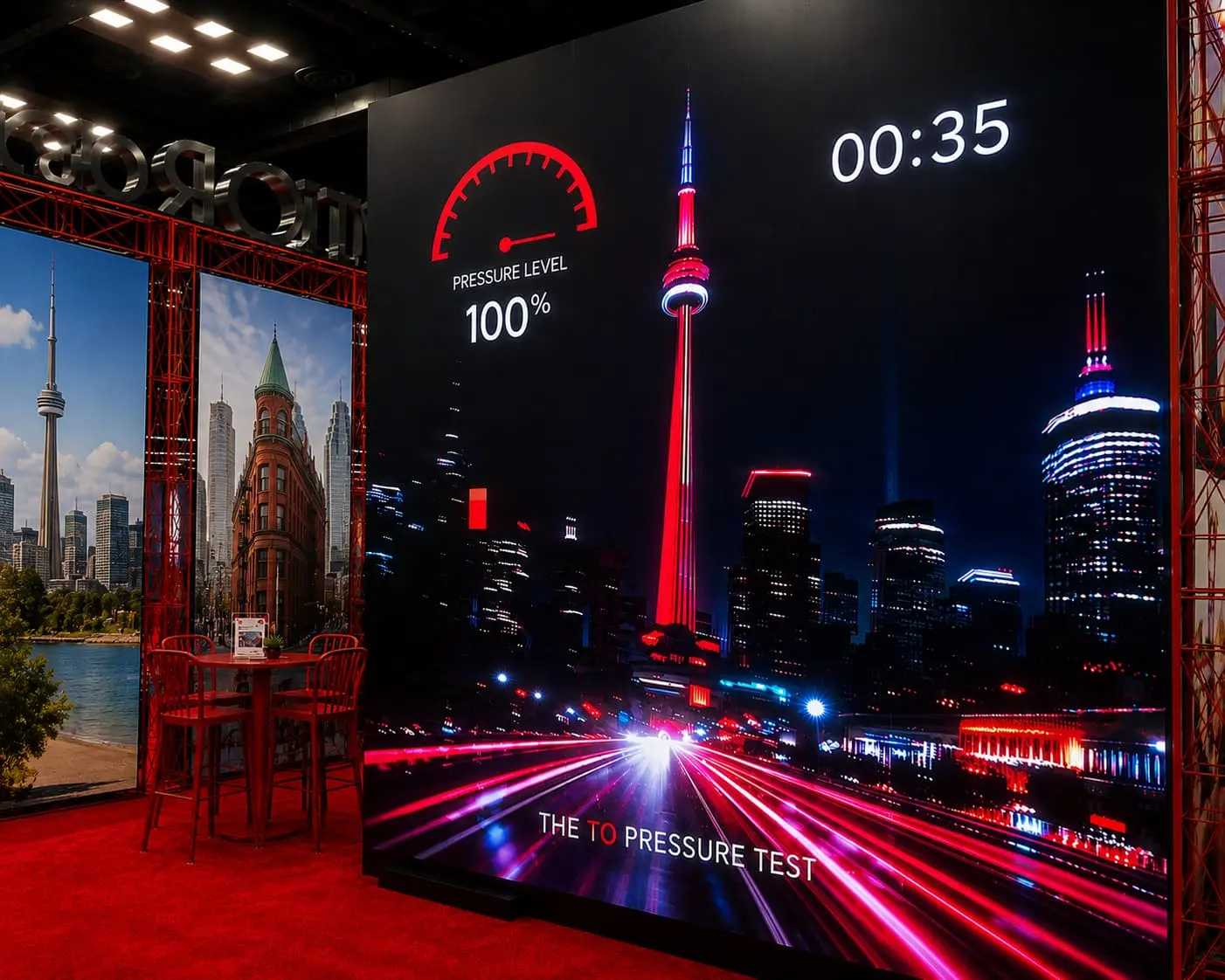
If you are planning an exhibition, product launch, visitor experience or immersive activation, our team would be delighted to explore how artificial intelligence can transform your vision into an unforgettable experience. One recent example is our MetaHuman Choir installation at IMEX Frankfurt 2026 — explore our full range of AI brand activation capabilities to see what is possible for your next event. Another recent example is Destination Toronto's TO Pressure Test at ASAE 2026, which shows a different application of AI — personalization rather than performance.
For a US event, explore our custom AI experience engineering and live deployment. For a trade show, see how these interactions can fit within an interactive exhibition stand.